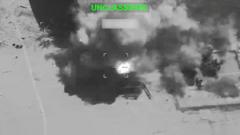
The United States launched its 11th consecutive night of military strikes against Iran as President Trump raised the possibility of attacking an underground nuclear facility. Secretary of State Marco Rubio indicated the campaign would persist as long as Tehran attempts to control the Strait of Hormuz, a vital international shipping route.
Speaking to Southeast Asian leaders in Manila on Wednesday, Rubio warned that Iran's demand to dominate the strait threatens global economic stability and freedom of navigation. "If we create a precedent in the Middle East where a nation state can decide that they are going to control an international waterway, charge a toll and if you don't pay them, blow up your ships, we have created a very dangerous precedent which will repeat itself in other parts of the world, including in this region," Rubio said.
Rubio accused Iran of breaking commitments made under a previous peace agreement. While acknowledging that Iran has contacted the United States both directly and indirectly about talks, Rubio offered no indication that Washington would consider returning to diplomatic negotiations.
The military pressure continues as shipping through the Strait of Hormuz declines sharply. On Tuesday, only three commodity vessels transited the narrow waterway connecting the Persian Gulf to the Gulf of Oman. No large crude carriers or liquefied natural gas tankers passed through the strait that day, according to shipping data from Kpler. The dramatic reduction in traffic reflects concerns about the escalating conflict near one of the world's most critical energy chokepoints, through which roughly one-fifth of global oil consumption flows.
Meanwhile, the conflict's economic impact is spreading. Gas prices in the United States have continued rising since the Iran conflict resumed this month, with the American Automobile Association reporting prices just over four dollars per gallon, nearly a dollar higher than a year ago. Brent Crude, the international oil benchmark, has climbed almost two percent to $90.92 per barrel.
The situation extends beyond the Persian Gulf. The Jordanian army reported intercepting four Iranian missiles on Wednesday, with two additional missiles landing in remote, uninhabited areas without casualties or property damage. In the Red Sea, a Houthi-run news agency claimed that six ships received warnings and were forced to reroute, though the claim could not be independently verified.
The repeated nights of American attacks represent a significant shift toward sustained military engagement rather than isolated strikes. The conflict carries substantial implications for regional stability and global energy markets. Continued military operations near critical shipping routes threaten oil supplies to major economies across Asia and Europe, while threats to Iranian nuclear facilities could trigger broader regional escalation and complicate international nuclear monitoring efforts.