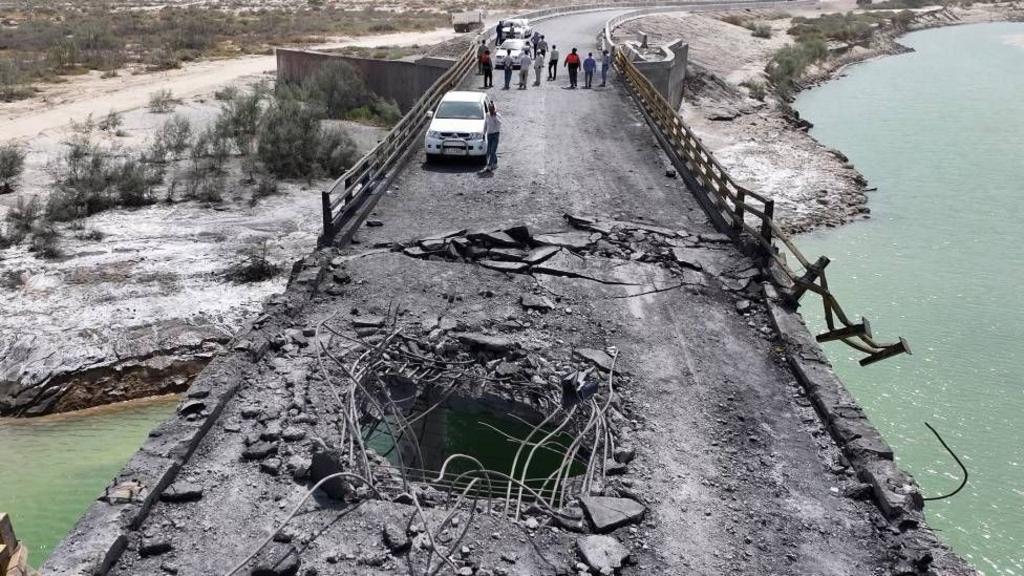
The U.S. military completed its seventh consecutive night of strikes against Iranian targets on Friday, with operations designed to "continue degrading Iranian military capabilities," according to U.S. Central Command. The escalating campaign has expanded well beyond military installations to include critical civilian infrastructure, raising serious humanitarian concerns.
American warplanes struck bridges in Iran's southern Hormozgan province, killing at least seven people according to Iranian state television. The bridges served as a key transit point for Bandar Abbas, Iran's main port. Additional strikes targeted a tower at Chabahar port on the Gulf of Oman, which the U.S. military claimed the Islamic Revolutionary Guard Corps used to coordinate attacks on vessels. Electrical infrastructure and Iranshahr airport also came under fire.
By Friday morning, Iranian health officials reported at least 38 deaths and more than 400 wounded from the American strikes. Iran's energy ministry urged citizens to reduce electricity and air conditioning usage after U.S. attacks strained the power grid, with southern regions experiencing "extreme heat and attacks on power infrastructure."
Iran has responded with its own strikes across the region. The Islamic Revolutionary Guard Corps targeted a U.S. air base in Bahrain, an intelligence facility, a naval fuel pier in Kuwait, and communications centers in Kuwait and Qatar. Kuwait suspended operations at its international airport following Iranian missile and drone attacks and confirmed that a power and desalination plant was hit, damaging the facility that provides about 90 percent of the country's drinking water.
The targeting of civilian infrastructure has drawn scrutiny from human rights experts, with some warning that strikes on nonmilitary facilities could constitute war crimes. The IRGC issued a statement warning of a "very severe and devastating price to pay" for countries hosting U.S. bases if attacks on civilians and civilian infrastructure continued.
Shipping through the Strait of Hormuz, which handles roughly a fifth of global oil and gas supply, has drastically reduced in recent days as violence escalated. Though a memorandum of understanding signed last month stated the strait should remain open to traffic, both nations interpreted the agreement differently, with competing plans for vessel transit.
The renewed fighting represents the unraveling of a ceasefire between the two nations. President Trump reportedly met with senior officials this week to discuss an expanded aerial campaign aimed at forcing Iran to reopen the strait. The conflict has now entered its seventh day, with both sides showing no signs of de-escalation. Iran has asked allied Houthi forces in Yemen to prepare to close the oil route through the Red Sea if the U.S. continues targeting Iranian energy infrastructure, a potential action that analysts warn could paralyze global energy markets.