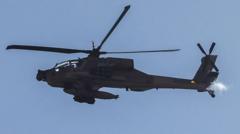
The United States launched military strikes against Iran on Tuesday after an American Apache helicopter went down near the Strait of Hormuz. President Donald Trump accused Iran of responsibility for the incident and directed the military to respond with strikes beginning at 10pm UK time.
US Central Command confirmed that the strikes targeted radar and air defense facilities along the strait. Trump stated on his Truth Social platform that the helicopter had been shot down and that Washington could not allow such an event to go unanswered. However, a US official told the Associated Press that the helicopter actually collided with an Iranian drone, though it remained unclear whether the collision was intentional.
The two crew members aboard the helicopter were rescued in an unprecedented operation using an unmanned drone boat called a Corsair, a 24-foot vessel. The aviators spent approximately two hours in the water before the drone located them. A military spokesperson described it as the first known drone rescue at sea by the US military.
Central Command characterized the military response as proportional, stating "The mission is a proportional response to unjustified Iranian aggression." Iranian Foreign Minister Abbas Araghchi responded on social media, warning that Iran "will leave no attack or threat unanswered. Leave our region if you want to be safe."
Trump downplayed the severity of the incident during an interview with the Wall Street Journal, saying the helicopter downing "wasn't a big deal" and that the "pilot is fine." He emphasized that the United States was not seeking full-scale war with Iran.
The confrontation threatens a ceasefire agreement announced in April between the two countries. This incident comes amid broader regional tensions, as Iran and Israel exchanged fire on Monday in what officials characterized as the biggest challenge yet to the fragile peace arrangement. Iranian state television reported that Israeli attacks killed at least two members of Iran's air defense units.
Despite the military escalation, Trump expressed optimism about ongoing negotiations with Iran. Before the helicopter incident, he had suggested there was "a good chance" of signing a deal within "two or three days," though he provided no details supporting this assessment. In previous statements, Trump indicated that expanded bombing campaigns could devastate Iranian infrastructure but would come at significant human cost and potentially disrupt shipping through the strategically vital Strait of Hormuz for months.
Vice President JD Vance suggested in an interview that the conflict could conclude within a week or several months. Iran's chief negotiator Mohammad Bagher Ghalibaf stated that Iran preferred diplomatic dialogue but warned of capability to respond through other means if commitments were broken.
The helicopter incident occurred while on patrol off the coast of Oman and highlights the ongoing tensions in the Gulf region as negotiations between the nations continue.