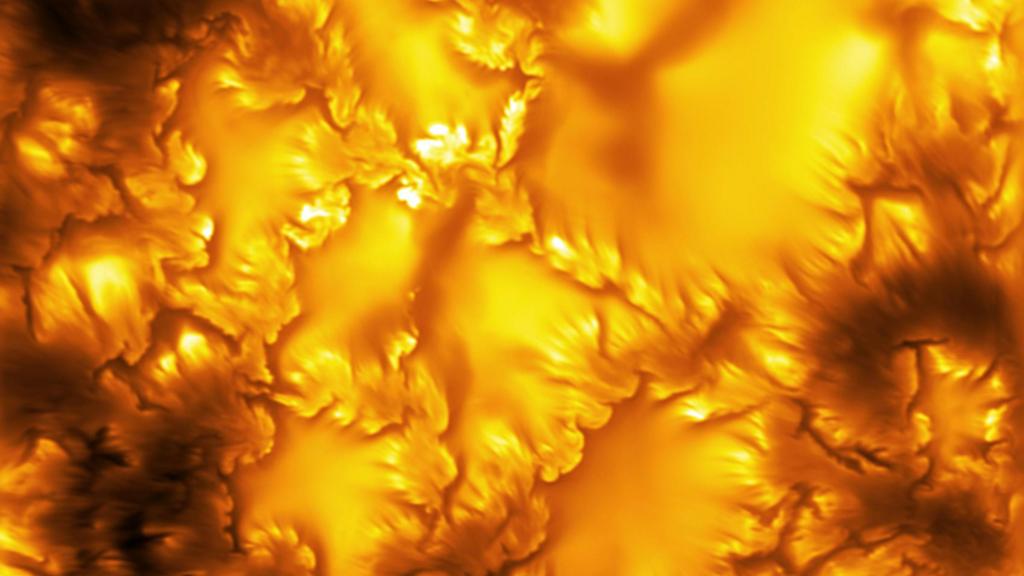
The Inouye Solar Telescope in Hawaii has captured the most detailed images of the sun's surface ever recorded, revealing previously unseen features that help explain how the sun generates its explosive activity. The images show swirling vortex structures smaller than 20 kilometers across, representing a major breakthrough in solar observation.
These new pictures reveal signatures of Kelvin-Helmholtz instabilities, a phenomenon where fast-moving plasma slides past slower-moving fluid, creating shear forces at their boundary. This interaction generates small disturbances that grow into spiraling vortices resembling breaking waves. While scientists have observed these instabilities in Earth's oceans, lakes, and cloud formations, as well as in the atmospheres of Jupiter and Saturn, confirming their existence on the sun represents a first.
"These are the highest spatial resolution images of the solar surface ever acquired," said Dr. Friedrich Wöger, a senior scientist at the National Solar Observatory, which operates the telescope near the summit of Haleakalā volcano on the island of Maui. The telescope's advanced capabilities allow it to see details right at the limits of what current technology can achieve.
Dr. David Kuridze, an astronomer involved in the research, expressed the team's amazement at the discovery. "This is something we have never seen before in any solar observations," he said, describing his reaction to the detailed images.
The findings, published in the journal Nature, have significant implications for understanding solar behavior. Explosive events on the sun, including solar flares, jets, and coronal mass ejections, are driven by fluctuating magnetic fields. These phenomena can cause widespread disruption on Earth by damaging power grids, satellites, GPS systems, and communications networks.
Scientists have long understood that magnetic field lines can twist around each other like braided hair, creating tension that releases energy when the lines break. However, what triggers this braiding process has remained unclear. The newly observed vortices appear to be a key factor in explaining how magnetic field lines become braided.
The discovery may also help solve a decades-long mystery in solar physics: why the sun's corona, its outer atmosphere, reaches temperatures of millions of degrees while the surface remains only about 6,000 degrees Celsius. According to Kuridze, the instabilities provide a mechanism for cascading energy into smaller scales, where it eventually dissipates as heat.
"This could solve this biggest mystery of the last half a century for solar physics and astrophysics," Kuridze said. Future observations from the Inouye Solar Telescope are expected to provide additional insights into how these small-scale processes contribute to large-scale solar phenomena and may ultimately improve space weather forecasting capabilities.