Former President Donald Trump announced plans to impose tariffs on Canada in response to wildfire smoke drifting across the border into American cities. In a post on Truth Social, Trump said the cost of the pollution "must of necessity be added to the TARIFFS Canada is currently paying."
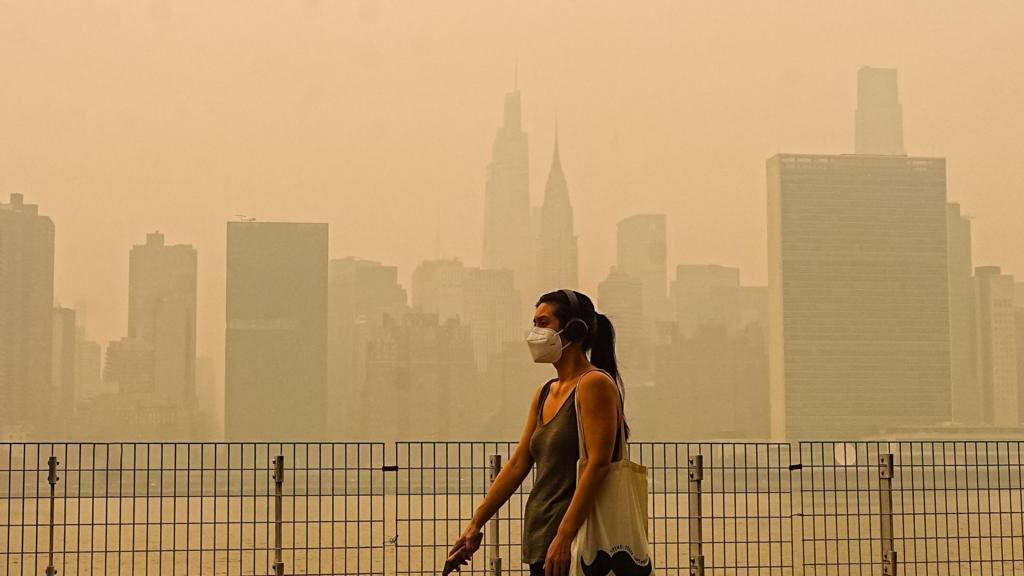
The proposal marks an expansion of tariff policy into environmental concerns, using trade measures to address cross-border air quality issues. Canadian wildfires have sent massive smoke plumes across the United States in recent years, affecting air quality in cities from the Midwest to the East Coast. About 109 million people faced poor air quality across the midwest, mid-Atlantic and northeast as smoke blanketed major cities. In Detroit and Chicago, residents were warned to stay indoors after air quality indexes reached hazardous levels of 361. Washington DC, Baltimore, New York City and Philadelphia also experienced very unhealthy to hazardous air quality readings.
Trump characterized the smoke as "dirty air" and said he planned to call Canadian Prime Minister Mark Carney to discuss Ottawa's plans for managing the blazes. Republican Senator Bernie Moreno of Ohio announced plans to introduce legislation to sanction Canada and Canadian government officials, claiming Canada had "failed to invest in wildfire prevention methods including forest thinning, fuel reduction, prescribed burns, and stronger enforcement against arson."
Four Republican House members representing Michigan also wrote to Carney, stating that if Canada would not manage its forests to prevent fires, "the United States will look elsewhere, and act on our own, to protect our people."
Carney responded to the accusations by stating that "fighting climate change is the responsibility of all countries, including the United States." Ontario Premier Doug Ford suggested the US offer more aid instead of complaining, noting that Canada had previously provided support to the US during similar situations. "Maybe what you should do rather than complain is send support, send help," Ford said.
Large fires are also burning across the US in what authorities deem an above-average fire year. More than 5,740 square miles of US land has burned from wildfires so far this year, 31 percent more than the average of the previous decade. Wildfires in Minnesota, Oregon, Washington and Idaho have contributed to smoke affecting both countries as prevailing wind patterns carry smoke across borders.
Scientists link increased wildfire activity to climate change driven by human activities, which is causing warmer, drier conditions and lengthening fire seasons. The US is the world's largest oil and gas producer and has historically emitted more greenhouse gases than any other country. The Trump administration has recently rolled back environmental protections while bolstering the fossil fuel industry and targeting renewable energy programs.