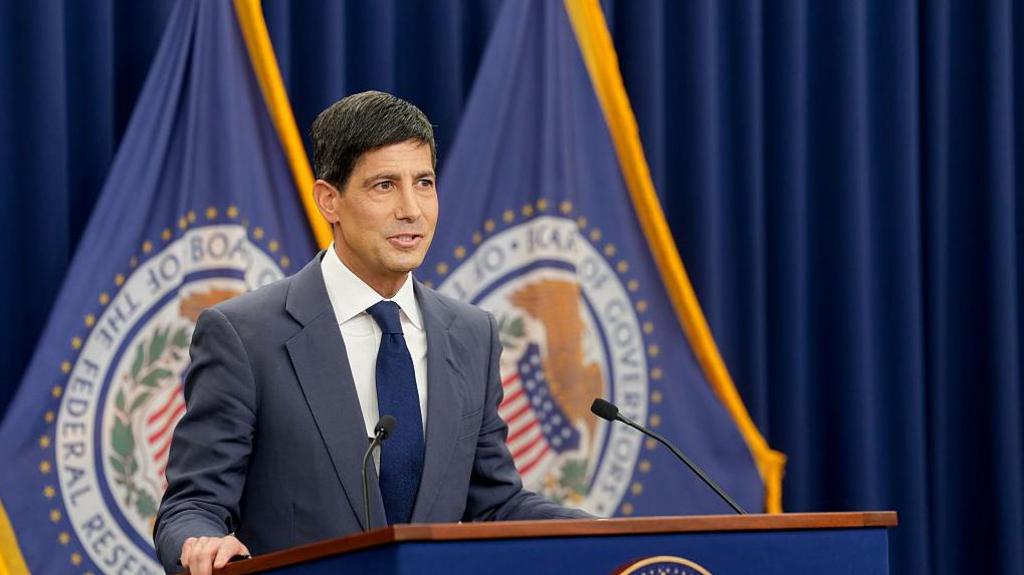
The Federal Reserve kept interest rates unchanged at its first meeting under new Chair Kevin Warsh, maintaining the benchmark rate in a range of 3.5% to 3.75%. However, the central bank signaled a notable shift in thinking, with nine of the Fed's voting members now projecting at least one rate increase before the end of the year.
The decision marked a significant departure from the Fed's outlook just three months earlier. In March, twelve of nineteen officials had projected rate cuts by year's end. The new projections represent a complete reversal in the committee's monetary policy direction as inflation concerns have intensified.
Stock markets reacted negatively to the announcement. The Dow dropped 500 points, while the S&P 500 and Nasdaq each fell more than 1.2% following the news.
The Fed's statement acknowledged economic challenges facing the country. "Economic activity is expanding at a solid pace despite elevated uncertainty that owes, in part, to the conflict in the Middle East," the committee said. Inflation has climbed to 4.2%, the highest level since 2023, driven primarily by energy price spikes related to Middle Eastern tensions. This remains well above the Fed's 2% target, though core inflation, which excludes volatile food and energy prices, has risen only modestly to 2.9%.
Warsh used his first press conference as chair to outline plans for reshaping the central bank's operations. He announced five new taskforces to examine the Fed's monetary policy approach, including its communications strategy, balance sheet management, data analysis, productivity assessments, and employment focus. One taskforce will specifically evaluate how the Fed communicates with the public, including its news conferences, dot-plot projections, and meeting transcripts.
The Fed's policy statement under Warsh's leadership was notably shorter than previous statements, reflecting his stated intention to tighten public communications on future guidance.
Notably, Warsh was the sole board member who did not contribute to the rate projections released by the committee. During his press conference, he declined to discuss whether he had met with President Trump since taking office.
The Fed chair emphasized that monetary policy has limited direct impact on commodity prices like oil and food costs. "The price of oil in the markets or the price of a dozen eggs does not have first-order consequences to what we're doing," he said. "But we have an important job there. And it's to make sure that those changes in oil, or beef, or eggs or milk don't broaden in the economy."
Meanwhile, the labor market has remained relatively resilient, with unemployment holding steady at 4.3%. However, hourly earnings growth has slowed to 0.7% on a seasonally adjusted basis, suggesting that wage gains have been eroded by rising prices.