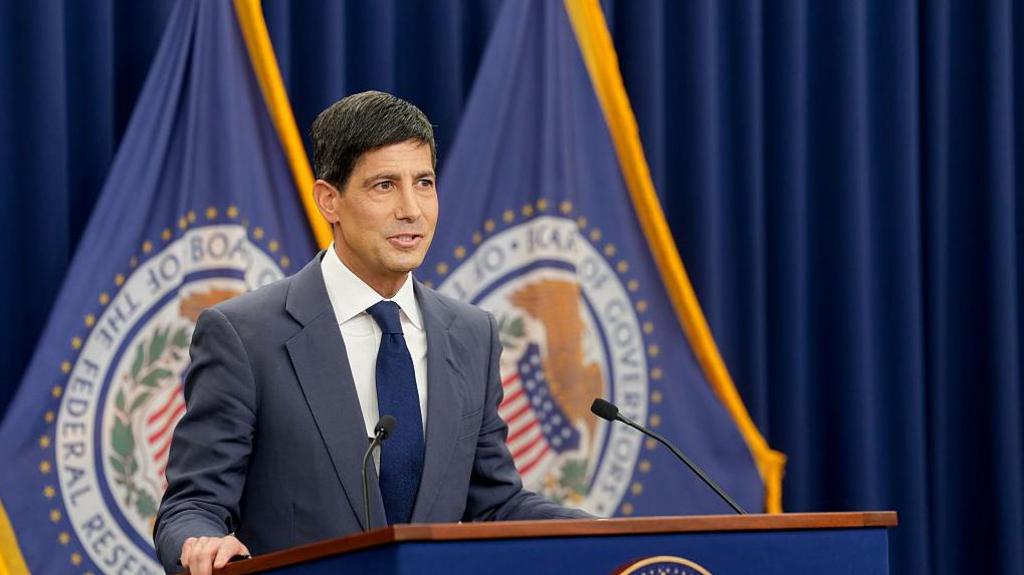
The Federal Reserve kept interest rates unchanged at its first meeting under new chairman Kevin Warsh, but signaled a possible rate increase before the end of the year. The central bank maintained rates in a range of 3.5% to 3.75%, where they have remained since December. The decision received unanimous support from the Fed's voting committee.
US stock markets initially dropped following the announcement, with the Dow closing 500 points lower and the S&P 500 and Nasdaq each falling over 1.2%. The Fed's statement acknowledged that "economic activity is expanding at a solid pace despite elevated uncertainty that owes, in part, to the conflict in the Middle East."
The policy shift became clear in the Fed's new economic projections, which showed nine of the voting members now expect at least one rate increase this year. This marks a dramatic reversal from March projections, when 12 of 19 officials predicted at least one rate cut by year's end. The change reflects growing concerns about inflation, which the Fed noted "remains elevated relative to the committee's 2% goal."
Warsh used his inaugural press conference to announce a comprehensive overhaul of how the Federal Reserve communicates with the public. He plans to create five new taskforces to assess the central bank's monetary policy approach, including its communications strategy, balance sheet operations, data practices, and labor market analysis. One taskforce will specifically examine how the Fed communicates through news conferences, economic projections, and meeting transcripts.
The new chairman emphasized that the Fed's monetary policy "cannot have a very significant effect on particularly prices," a notable shift from his reputation as an inflation hawk during his previous tenure as a Fed governor from 2006 to 2011. He stated that while energy prices and food costs do not have first-order consequences for Fed policy, the central bank must prevent such changes from spreading more broadly throughout the economy.
The Fed's policy statement was notably shorter than previous statements, reflecting Warsh's stated desire to tighten the central bank's public communications. Warsh confirmed he was the only board member who did not contribute to the economic projections released Wednesday.
The decision comes as the US economy faces significant pressures. Inflation reached 4.2 percent, the highest level since 2023, driven largely by energy prices following conflict in the Middle East. Although hourly earnings dropped to a seasonally adjusted 0.7 percent, core inflation has risen only mildly to 2.9 percent. The unemployment rate has remained steady at 4.3 percent, indicating continued labor market strength.
Officials will continue monitoring economic conditions and inflation data as they determine whether rate increases become necessary in coming months.