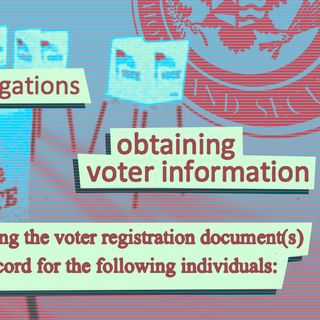
Immigration and Customs Enforcement investigators have obtained individual voter files directly from local election officials in two counties, according to emails shared with Axios. The agency bypassed state-level channels to access the records as part of an expanding federal effort to investigate alleged noncitizen voting.
President Trump has long maintained that millions of people, including noncitizens, voted illegally in the 2016 and 2020 elections. He has cited these claims as the reason he lost the popular vote in 2016 and the general election in 2020. What was once Trump's personal assertion has now evolved into a coordinated multi-agency initiative that reaches directly into state and local voter systems.
The shift in approach is notable. Rather than working through state election boards or secretaries of state, ICE investigators are contacting county election officials directly to obtain voter data. This marks a significant change in how federal immigration authorities interact with local voting infrastructure and raises questions about the appropriate relationship between immigration enforcement and election administration.
The actual scope of documented noncitizen voting is far smaller than Trump's claims suggest. The Heritage Foundation, a conservative think tank that tracks voter fraud convictions and court records, has documented only 100 cases of noncitizen voting between 1982 and 2025. Election officials and voting rights advocates have long noted that existing safeguards in voter registration systems effectively catch the vast majority of ineligible applicants before they can vote.
Federal law already prohibits noncitizens from voting in federal elections, with violations carrying potential criminal penalties including fines and deportation. This legal framework means existing protections are already in place.
The extent of ICE's data collection effort remains unclear from the available information. The two counties where voter files were obtained have not been publicly identified. Federal officials have not disclosed how many additional jurisdictions may have received similar requests or what specific information ICE is seeking from voter registration records.
The effort comes as Trump has moved to significantly increase resources for immigration enforcement. Earlier this week, he signed a new law giving the Department of Homeland Security roughly 70 billion dollars in additional funding, which bankrolls his mass deportation campaign through the end of his term.
This direct access to local voter systems represents an expansion of federal immigration enforcement into areas traditionally managed by state and local election officials. The approach raises concerns among voting rights advocates about the potential for misuse of voter data and the blending of immigration enforcement with election administration activities.