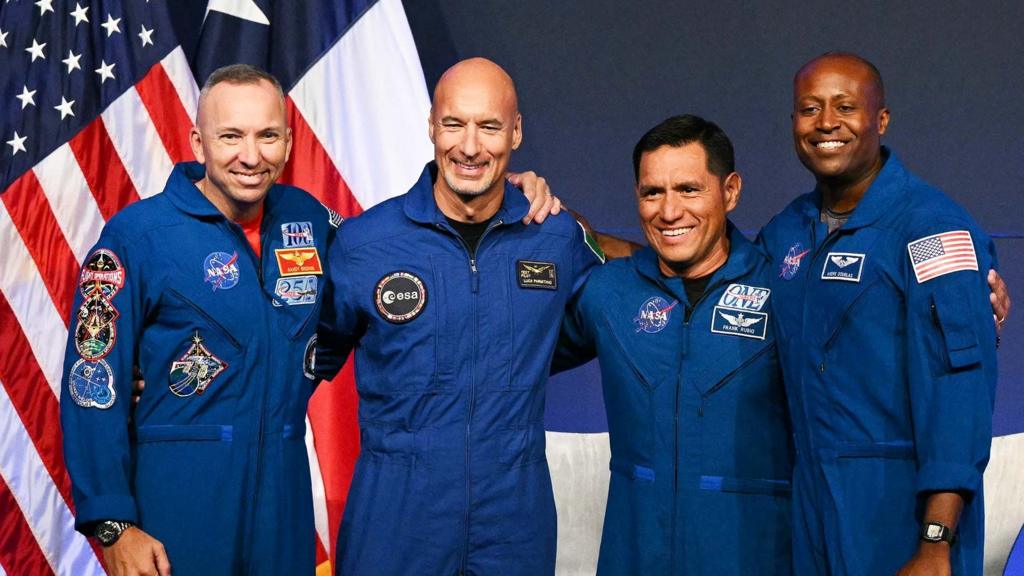
NASA announced the crew for its Artemis III mission on Tuesday, selecting four astronauts who will test critical systems ahead of humanity's return to the Moon. The crew includes three Americans and one Italian astronaut from the European Space Agency, marking the first time a European has been selected for the Artemis program.
The four-person team consists of Randy Bresnik, who will serve as mission commander, along with Frank Rubio and Andre Douglas of NASA, and Luca Parmitano of the European Space Agency. Bresnik is a Marine Corps colonel and former commander of the International Space Station with over 7,000 hours of flying experience. Rubio, an Army Black Hawk helicopter pilot and flight surgeon, holds the record for the longest single spaceflight by a NASA astronaut at 371 days. Douglas, a systems engineer and Coast Guard reserve officer, brings no previous spaceflight experience but trained as a backup crew member for the Artemis II mission.
Parmitano, an Italian fighter pilot, will serve as pilot for the mission. He has an asteroid named after him and was the first disc jockey to broadcast from space. In 2013, he experienced a near-fatal incident when his helmet filled with liquid during a spacewalk on the International Space Station.
Unlike its predecessor Artemis II, which looped around the Moon in April 2026, the Artemis III crew will remain in lower Earth orbit. Their two-week mission scheduled for 2027 will focus on testing docking procedures and life support systems for two competing lunar lander designs from Blue Origin and SpaceX. The crew will practice docking their Orion capsule with both the Blue Moon lander and SpaceX's Human Landing System.
NASA Administrator Jared Isaacman described the initiative as "Earth's first starfleet" during the announcement ceremony at Houston's Johnson Space Center. He emphasized the scope of the operation, noting that multiple spacecraft from various international partners would eventually operate in orbit simultaneously, including vehicles from Russia and China.
The Artemis III mission represents a critical stepping stone toward Artemis IV, the planned first crewed lunar landing since 1972, scheduled for 2028. Unlike the brief Apollo missions, the Artemis program aims to establish a sustainable human presence on the Moon through longer stays and the construction of a permanent lunar base.
The announcement comes as NASA continues to address technical challenges within the program. Blue Origin recently experienced a significant anomaly with its New Glenn rocket on May 28, which destroyed the launchpad in Florida. Company and NASA officials expressed confidence that repairs would be completed in time for the Artemis III mission.