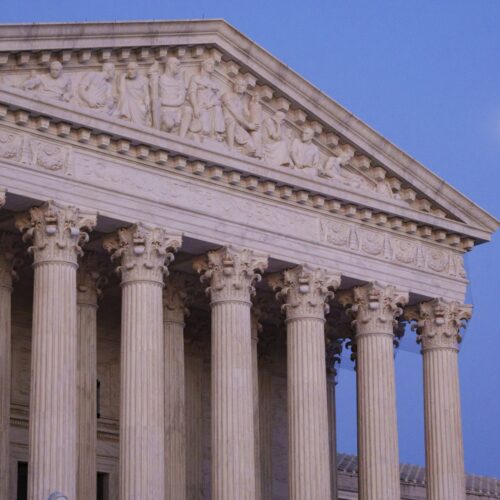
The Supreme Court has agreed to decide whether President Trump's executive order restricting birthright citizenship is constitutional. The justices will hear arguments in the spring, with a ruling expected by early summer, before the court's scheduled recess.
Trump issued the order shortly after taking office for his second term, directing federal agencies not to recognize citizenship for children born in the United States if neither parent is a citizen or legal permanent resident. The order was immediately blocked by multiple federal judges who found it likely violated the Constitution, federal law, and Supreme Court precedent. Trump appealed to the Supreme Court to overturn these injunctions.
The case, known as Trump v. Barbara, stems from New Hampshire, where a federal judge blocked the order in a class-action lawsuit led by the American Civil Liberties Union on behalf of affected children and parents. The lower court ruled that Trump's policy violated the 14th Amendment and a federal law that codifies birthright citizenship rights.
The 14th Amendment, ratified after the Civil War to ensure citizenship for freed Black Americans, states that "all persons born or naturalized in the United States, and subject to the jurisdiction thereof, are citizens of the United States." This principle has been settled law for over 150 years.
Trump's administration has adopted a once-fringe legal theory pushed by hardline immigration activists, arguing that the common understanding of the amendment is incorrect. The administration claims the citizenship clause was intended only for freed slaves and their children, not for children of temporary visitors or undocumented immigrants. Solicitor General John Sauer wrote that the order is necessary because birthright citizenship has become an incentive for illegal immigration.
If allowed to take effect, the order would deny automatic citizenship to tens of thousands of children born annually in the United States. These children would lose eligibility for government programs supporting low-income families, including food assistance and subsidized health insurance. Newborns requiring intensive hospital care would no longer qualify for Medicaid.
The ACLU's national legal director, Cecillia Wang, stated that "no president can change the 14th Amendment's fundamental promise of citizenship." She noted that federal courts have unanimously held that Trump's order contradicts the Constitution, a Supreme Court decision from 1898, and laws enacted by Congress.
The United States is among roughly 30 countries, including Canada and Mexico, that grant automatic citizenship to nearly all people born within their borders. The Supreme Court's decision on birthright citizenship could reshape how the country defines national membership and citizenship rights.