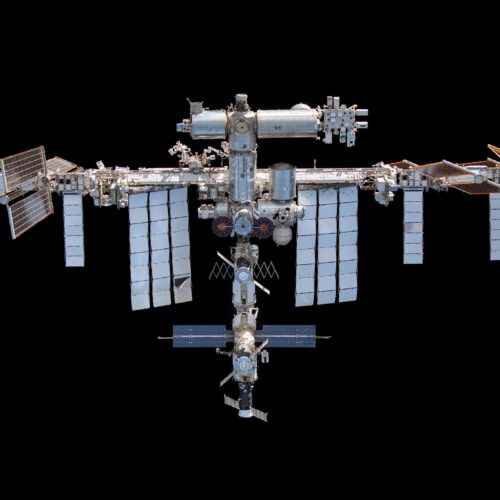
Five astronauts aboard the International Space Station received orders to shelter in docked spacecraft and prepare for possible evacuation on Friday after air leaks were discovered in a Russian module, NASA confirmed. The crew returned to normal station operations about two hours later after the agency lifted the shelter order.
NASA instructed the four members of SpaceX Crew-12 and a fifth American astronaut to enter their Crew Dragon spacecraft and don spacesuits as a precautionary measure while Russian specialists assessed the situation. The four Crew-12 members included American astronauts Jessica Meir and Jack Hathaway, French astronaut Sophie Adenot, and Russian cosmonaut Andrey Fedyaev. American astronaut Chris Williams, who has been at the station for 190 days, also sheltered in the spacecraft alongside Russian cosmonauts Sergey Kud-Sverchkov and Sergey Mikayev.
The two air leaks were located in the transfer tunnel of the Zvezda Service Module, a 43-foot-long Russian compartment that contains living quarters, life support systems, communications equipment, electrical power distribution, and propulsion systems. Specialists detected the leaks while pressurizing the transfer chamber and quickly sealed one leak site using a two-component sealant called Germetal-1. The second potential leak site was identified in the conical portion of the transfer chamber.
According to Roscosmos, the Russian space agency, there was no immediate threat to crew safety or station systems. However, the agency paused further structural repair efforts while engineers gathered more measurements and data.
"Given this development, NASA has instructed the crew members inside the Dragon spacecraft to end the safe haven procedures and return to planned operations aboard the International Space Station," NASA spokesperson Bethany Stevens said. "We look forward to working with Roscosmos on a collaborative approach to address the leaks."
The air leaks reflect an ongoing challenge for the International Space Station. Roscosmos has dealt with cracks and leaks in Russian station compartments for more than five years, with NASA's Office of Inspector General identifying them as a top safety risk. In June, a planned mission carrying India's, Poland's, and Hungary's first astronauts in decades was postponed due to leak concerns.
The International Space Station operates approximately 250 miles above Earth as a collaborative effort between NASA, the Russian State Space Corporation, the European Space Agency, the Canadian Space Agency, and the Japan Aerospace Exploration Agency. The station has maintained continuous human presence for 25 years. It is divided into two sections: the Russian Orbital Segment managed by Roscosmos and the US Orbital Segment operated by the other agencies.