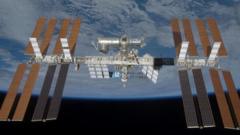
NASA instructed five astronauts aboard the International Space Station to shelter in their docked Dragon spacecraft and prepare for potential evacuation while Russian engineers attempted repairs on air leaks in the station's Russian segment.
The four crew members of NASA's SpaceX Crew-12 mission and a fifth American astronaut, Chris Williams, who had been aboard the station for 190 days, received the shelter order. Williams sheltered alongside Jessica Meir, Jack Hathaway, Sophie Adenot of the European Space Agency, and Russian cosmonaut Andrey Fedyaev.
The air leaks were discovered in the transfer tunnel of the Zvezda Service Module during pressurization of the transfer chamber. Two separate leak sites were identified. Russian specialists quickly sealed one leak using a two-component sealant called "Germetal-1." The second potential leak was located on the conical portion of the transfer chamber.
Roscosmos stated there was no immediate threat to crew safety or station systems. However, the discovery prompted NASA to take precautionary measures by having the crew move to the Dragon spacecraft, which serves as an emergency evacuation vehicle if needed.
After approximately two hours of sheltering, NASA instructed the astronauts to end the safe haven procedures and return to normal operations aboard the station. "Roscosmos has paused Friday's structural repair efforts inside the Zvezda service module transfer tunnel, known as PrK, as more measurements and data is assessed," said Bethany Stevens, a NASA spokesperson.
The Zvezda Service Module is a critical component of the ISS. The 43-foot-long module contains living quarters, life support systems, communications equipment, electrical power distribution, data processing systems, flight control systems, and propulsion systems. It includes docking ports for Russian Soyuz and Progress spacecraft and was the first fully Russian contribution to the station.
Air leaks have been a persistent concern for the Russian segment of the ISS. Roscosmos has dealt with cracks and leaks in its station compartments for more than five years. NASA's office of inspector general has identified these leaks as "a top safety risk." In June, a chartered spaceflight for India, Poland, and Hungary's first astronauts in decades was postponed due to leak concerns.
The International Space Station, located approximately 250 miles above Earth, has maintained continuous human presence for 25 years. The station is operated by five partner agencies: NASA, the Canadian Space Agency, the European Space Agency, the Japan Aerospace Exploration Agency, and Roscosmos. The station is divided into two segments, with Roscosmos managing the Russian Orbital Segment and NASA, along with ESA, JAXA, and CSA, operating the US Orbital Segment.