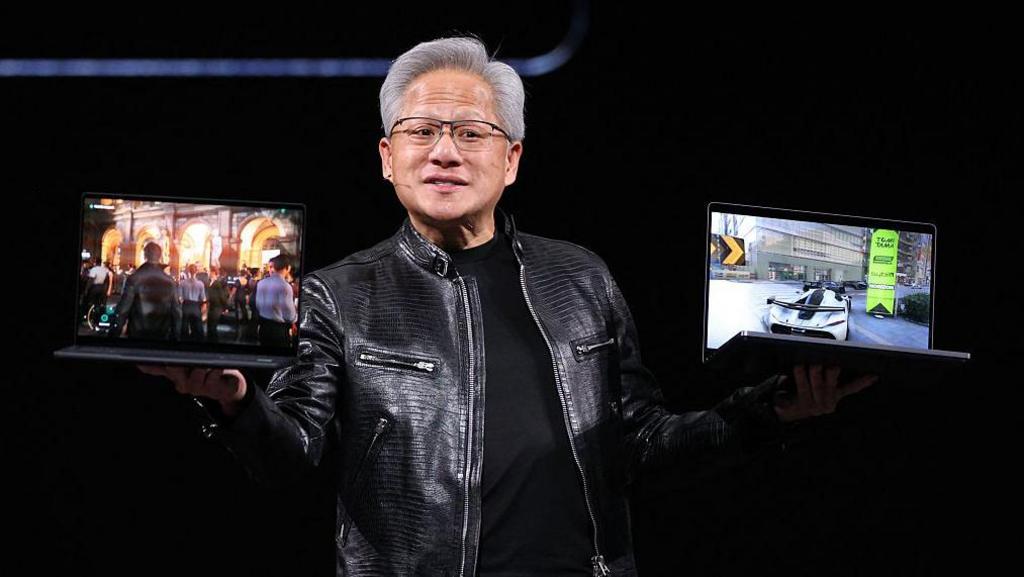
Nvidia has unveiled the RTX Spark, a new superchip designed to bring artificial intelligence capabilities directly into laptops and desktop computers. The chip represents a significant expansion of Nvidia's reach beyond its dominant position in data center processors.
The RTX Spark combines a microprocessor and graphics chip, developed with assistance from Taiwan's MediaTek. Unlike current systems that rely on cloud computing for AI tasks, the new chip enables AI agents to run locally on personal computers. This allows these agents to navigate PCs autonomously, potentially replacing traditional mouse and keyboard interactions.
Nvidia CEO Jensen Huang announced the development at the Computex conference in Taiwan, describing it as reinventing the PC "for the first time in 40 years." The chip will launch this year and be integrated into devices from major computer manufacturers including Dell, Lenovo, Asus, and HP, running on Microsoft's Windows software. The collaboration between Nvidia and Microsoft has spanned three years.
Despite the chip's powerful capabilities, Nvidia states that computers using it will remain thin and lightweight. The company designed the RTX Spark to handle demanding AI processing while maintaining the portability users expect from modern laptops.
This move positions Nvidia in direct competition with established PC chip makers including Intel, Apple, Qualcomm, and AMD. Industry analysts have drawn comparisons between this moment and major technological shifts like the iPhone's launch and the emergence of ChatGPT.
Neil Shah, co-founder of Counterpoint Research, characterized the RTX Spark as potentially transformative. "The RTX Spark looks to transform the traditional app-centric PC to a real useful agentic AI personal computer which will eventually be in every home in coming years as private edge AI agents become pivotal," Shah said.
Nvidia is also developing the Vera CPU, another processor designed for AI agents. Early adopters of Vera include OpenAI, Anthropic, and SpaceX.
The expansion reflects Nvidia's broader strategy to extend its influence across multiple layers of the AI technology stack. While the company currently dominates the market for AI infrastructure and data center computing power, industry observers view the consumer PC market as a longer-term opportunity. Analyst Susannah Streeter noted that Nvidia's foray into personal computers "marks a bold attempt to extend its dominance beyond datacentres and into consumers' everyday lives," though investors likely see this as a growth opportunity rather than an immediate earnings driver.
Competing manufacturers are responding to Nvidia's push. Intel intends to ship an AI chip later this year that uses cheaper memory and cooling technology. The company announced a new graphics processing unit called Xe3P, codenamed Crescent Island, which is "purpose-built for this upcoming AI generation of agents," according to Intel's vice-president of AI products.