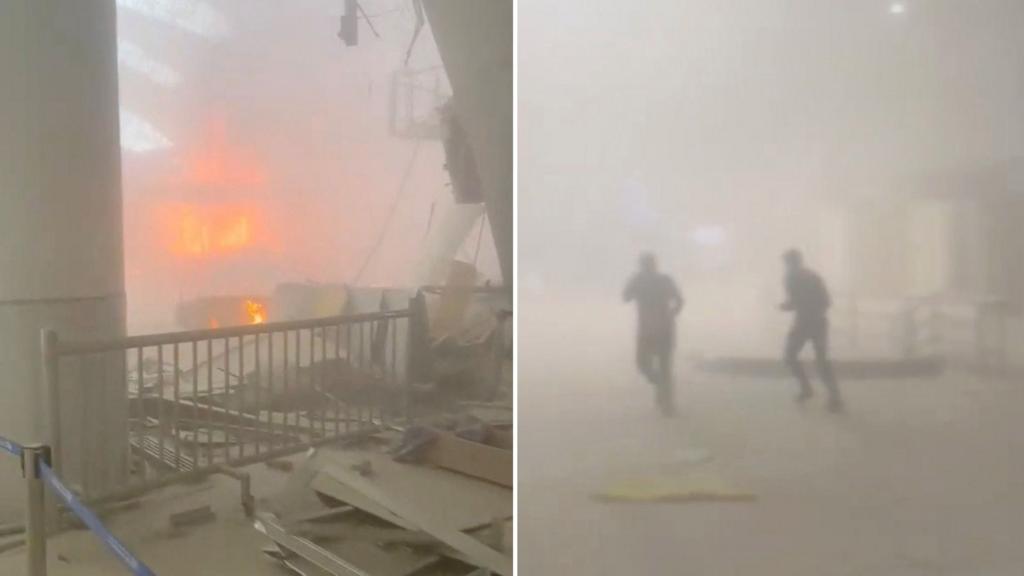
Iran launched drone strikes at Kuwait's international airport on Wednesday, killing at least one person and wounding 63 others in the first deadly attack in the Gulf region since a ceasefire took effect on April 8. The assault struck a passenger terminal building and came the same day Secretary of State Marco Rubio told Congress that the Iran war was "concluded," highlighting the precarious state of diplomatic efforts.
The attack followed a cycle of military exchanges between US and Iranian forces. American Central Command said it had targeted an unladen oil tanker near the Strait of Hormuz on Tuesday, firing a Hellfire missile to disable the vessel's engine as it passed through international waters toward Iran. The crew had allegedly ignored repeated warnings over a 24-hour period.
Iran's military responded with the drone strike on Kuwait's airport. The country's foreign ministry blamed Kuwait and Bahrain for allowing the United States to use their territory, saying the incident "emphasises the direct and unmistakable responsibility of the leaders of Kuwait and Bahrain for last night's acts of aggression."
US forces subsequently reported shooting down three Iranian drones launched toward civilian vessels in the region. Iran's Islamic Revolutionary Guard Corps claimed it had attacked the US Fifth Fleet headquarters in Bahrain with missiles and drones, though US Central Command denied this claim. The military adviser to Iran's supreme leader, Mohsen Rezaee, threatened escalation, stating: "Every shot fired and every attack will be met with a deluge of missiles and drones."
Kuwait's defense ministry characterized the attack as "criminal Iranian aggression" and suspended air traffic, diverting incoming flights to alternative airports. Kuwait subsequently ordered a reduction in Iranian embassy staff, declared two Iranian diplomats persona non grata, and gave them 24 hours to leave the country.
President Trump said in an interview released Wednesday that negotiations with Iran were continuing and that he was not seeking escalation, stating: "We don't need boots on the ground now." He also said he would like to meet Iran's supreme leader, Mojtaba Khamenei, "depending on how it all works out."
Israeli Prime Minister Benjamin Netanyahu warned that Trump could order a "full-scale return to military action" if negotiations fail, saying "Israel is ready, and the US forces are ready."
Rubio's congressional testimony about the war's conclusion directly contradicted events unfolding on the ground. He had claimed a deal was within reach and that Tehran had agreed to negotiate nuclear program aspects it previously refused to discuss. However, Iran's foreign minister indicated the country would suspend peace talks in protest against Israel's offensive in Lebanon, threatening to derail negotiations with Washington.
The latest military exchanges underscore the fragility of the ceasefire arrangement and the significant obstacles to achieving a diplomatic resolution.